


“What we see with gentrification is, as people are being pushed out, it has a direct impact on the culture of the place – the businesses, the cultural institutions, and the cultural landmarks that identify a community or make a community…it’s more than just about houses.”
-“Naiomi” (E. Austin), from The Fighting Displacement Study
Places can hold deep meaning. In a series of studies using photographic and visual methods, we explore how culturally relevant places – Black neighborhoods and third places – form cognitive maps that help foster a feeling of belonging, inclusion, and place attachment for older Black adults. Historically Black spaces and neighborhoods, from Harlem to Oakland to the Albina District in Portland, become embodied, contributing to collective memory-making and remembering among older adults, and particularly for those living in gentrifying neighborhoods.
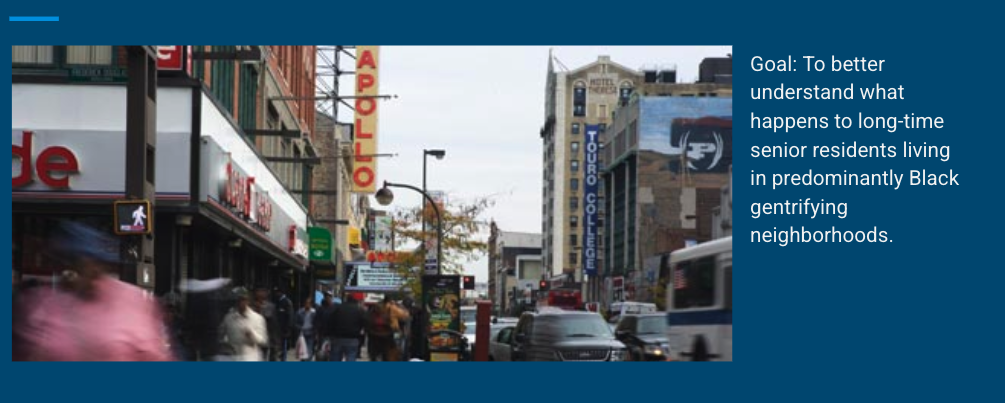
Using a participatory geography approach, Croff and Versey (under review) combine and leverage data from the Harlem Gentrification Project (HGP) and the Sharing History through Active Reminiscence and Photo-imagery (SHARP) study. SHARP engages older Black adults in reminiscence while walking pre-planned routes that pass culturally meaningful locations, revealing how place, walking, and social engagement may contribute to remembering. Our analysis suggests that collective place remembering can occur through, but not limited to, four pathways: (1) images and observation of culturally relevant third places, (2) triadic recall, (3) social actors anchored to place, and (4) experiences of belonging. It is likely that amidst gentrification, culturally relevant third places become particularly salient cues for recalling embodied memories of place, and gentrification can disrupt these memories and maps, rendering places harder to recall. Place-based walking methods may support positive cognitive outcomes (e.g., memory-making) facilitated through embodied spatial processes. Expanding place-based memory interventions may offer promising pathways for supporting cognitive health and social connection among older adults.